


Historic Theatres of the US & UK
Inside Leeds Grand Theatre: History, Famous Performers & Victorian Grandeur
Step inside one of England's great surviving Victorian theatres and discover nearly 150 years of opening-night drama, famous performers, opera, pantomime, architectural spectacle and stories that refuse to stay backstage.
The Grand Old Lady of Leeds has stories to tell.
Some theatres host history. Others become part of it.
Leeds Grand Theatre has been doing both since 1878.
Standing on New Briggate in the heart of Leeds, this spectacular Victorian theatre has survived changing tastes, two world wars, the arrival of cinema and television, threats to its future, extensive restoration and nearly a century and a half of audiences gathering for one simple reason:
To see something happen live.
Its stage has welcomed Shakespeare, opera, ballet, pantomime, serious drama, blockbuster musicals and performers whose names became part of British theatrical history.
Best of all, this isn't a beautiful old building waiting quietly for visitors to admire it.
The orchestra still plays.
The lights still dim.
The curtain still rises.
Leeds Grand Theatre at a Glance
Before we wander through nearly 150 years of theatre history, here are a few essentials about the building at the centre of the story.
A Theatre Born in Victorian Leeds
The story begins before the theatre itself existed.
Victorian Leeds was expanding rapidly, fuelled by industry, commerce and population growth. The city needed cultural spaces capable of matching its growing importance.
A story preserved in Leeds theatre history dates the spark back to 1858, when Queen Victoria and Prince Albert visited Leeds.
Prince Albert reportedly remarked that the town needed a good theatre — somewhere capable of encouraging culture and raising the tone of the city.
Leeds eventually took the hint.
Then the need became rather urgent.
In 1875, two existing Leeds theatres were destroyed by fire within a matter of months.
The losses strengthened the case for something new, ambitious and considerably grander.
A group of local businessmen backed plans for a major new theatre.
Prominent Leeds architect George Corson designed the building with assistance from James Robertson Watson.
Construction began in 1877.
About thirteen months later, Leeds had a theatre that was clearly not interested in understatement.

Opening Night: November 18, 1878
Imagine Leeds on a November evening in 1878.
Carriages arrive. Theatre-goers stream toward a brand-new building. Inside, audiences encounter an enormous auditorium filled with Victorian decoration and a stage waiting for its first official performance.
The production chosen to open Leeds Grand Theatre was Shakespeare's Much Ado About Nothing.
The first curtain rose on Monday, 18 November 1878.
The theatre's first manager, actor Wilson Barrett, appeared as Benedick.
Contemporary accounts praised not only the performance but also the building itself, particularly its comfort, sightlines and acoustics.
The original theatre could accommodate approximately 2,600 seated patrons, with room for hundreds more standing.
Victorian audiences weren't merely getting a new local playhouse.
Leeds had built a Grand.
Look Up. Look Around. The Building Is Part of the Show.
One of the great pleasures of visiting a historic theatre is remembering that the performance isn't the only thing worth watching.
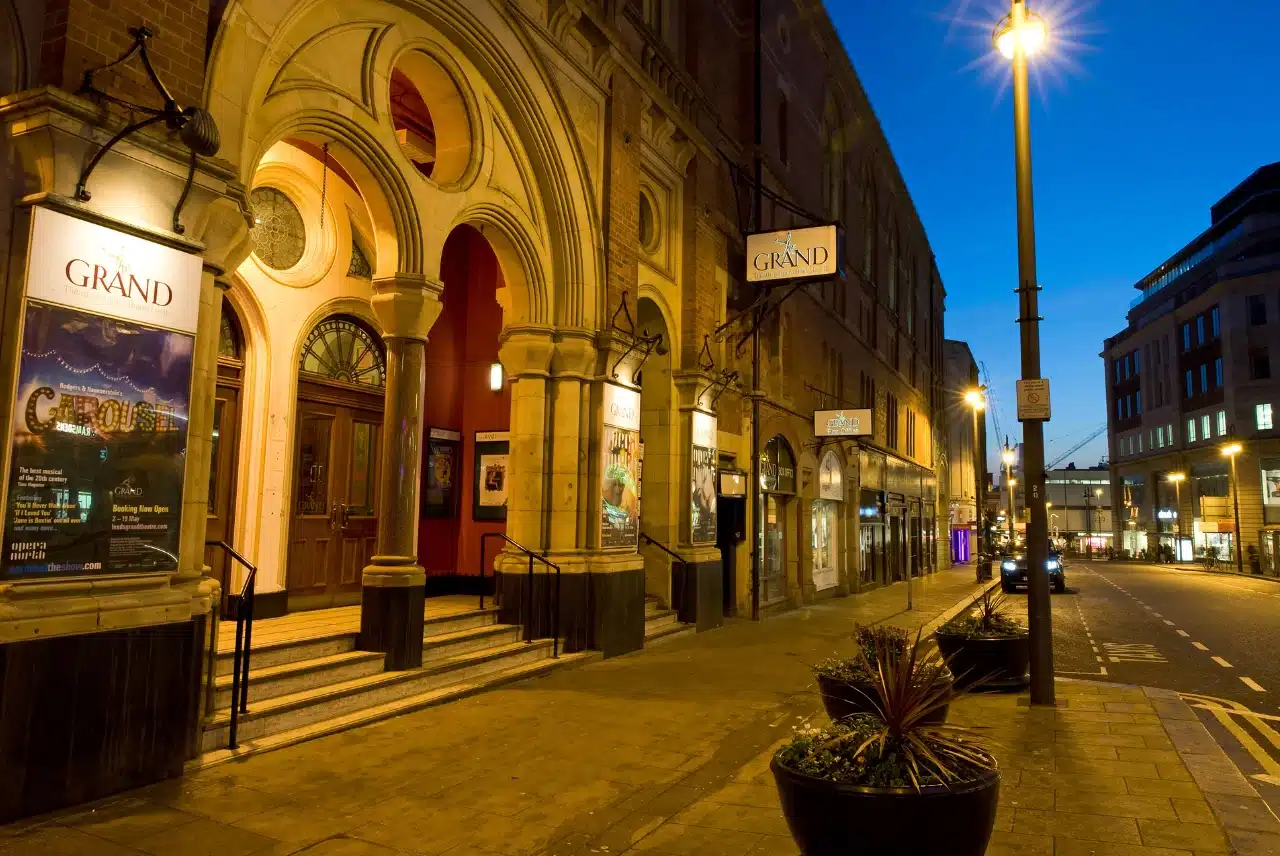
Leeds Grand Theatre surrounds audiences with ornate plasterwork, decorative balconies, rich fabrics, sweeping staircases, gilded details and Victorian craftsmanship.
The building draws from a wonderfully theatrical mixture of architectural influences, including Gothic, Romanesque and Scottish Baronial styles.
On paper, that sounds like an architect had several excellent ideas and politely declined to choose just one.
In person?
It works.


Who Has Walked This Stage?
A theatre that has operated since 1878 doesn't simply collect programmes and posters.
It collects generations of performers.
Leeds Grand Theatre's archives connect its stage with some extraordinary names from British theatre and screen history.
Laurence Olivier
Olivier appeared at The Grand during the National Theatre's celebrated 1964 visit, including in Henrik Ibsen's The Master Builder.
Maggie Smith
Maggie Smith performed during the National Theatre's 1964 Leeds season, including in The Recruiting Officer.
Michael Gambon
Decades before international film audiences knew him as Dumbledore, Gambon appeared at The Grand in the 1964 National Theatre season.
Derek Jacobi
Jacobi's relationship with the Leeds stage stretched across multiple years and productions, with appearances documented across several decades.
Ian McKellen
McKellen performed at The Grand in major classical roles, including Richard II and Hamlet.
Eileen Atkins
Atkins appeared in productions including The Cocktail Party and later National Theatre work at Leeds Grand Theatre.
Alec Guinness
The celebrated stage and screen actor appeared at The Grand in a production of T. S. Eliot's The Cocktail Party.
Lesley Manville
Before decades of acclaimed stage and screen performances, Lesley Manville appeared in Leeds Grand Theatre's pantomime tradition.
One stage. Many generations.
That's one of the magical things about historic theatres.
Performers who never shared the same decade can still share the same physical stage.
The scenery changes. The audiences change. The world outside changes.
The theatre remembers all of them.

From Shakespeare to Panto to Blockbuster Musicals
Nearly 150 years of programming cannot be squeezed into a tidy greatest-hits list.
Leeds Grand Theatre has continually adapted to changing audiences while remaining unmistakably theatrical.
Victorian Drama
Shakespeare and touring dramatic companies helped establish The Grand from its earliest years, beginning with Much Ado About Nothing.
Pantomime
Panto became part of the theatre's story almost immediately, connecting generations of Leeds families with festive live entertainment.
Opera & Ballet
Opera and dance became central to the venue's identity and remain important parts of its artistic life today.
Touring Musicals
Modern audiences have seen major West End and touring productions arrive through the same doors once used by Victorian theatre-goers.
A Victorian Pantomime Title That Refused to Be Brief
One early production carried the spectacularly Victorian title:
Blue Beard; Or, Harlequin the Amorous Ameer of Afghanistan
Apparently nobody on the marketing team was being paid by the word.
Pantomime became a lasting part of The Grand's entertainment tradition, alongside drama, comedy, musicals, dance and opera.
Opera, Ballet & a Theatre That Became Home
Leeds Grand Theatre has a particularly important relationship with opera and ballet.
Major opera companies appeared at The Grand throughout its history, bringing ambitious productions to Leeds audiences.
In the 1970s, that relationship became even more significant.
Opera North finds its home.
Leeds Grand Theatre became home to the company that developed into Opera North, with its first productions at The Grand arriving as the theatre approached its centenary.
The theatre also developed a long relationship with Northern Ballet, connecting two major performing arts companies with one of Leeds' most recognisable cultural buildings.
That combination is one reason The Grand is more than a surviving Victorian theatre.
It remains part of the working infrastructure of British performing arts.
The Grand Nearly Wasn't Here to Tell the Story
Historic theatres can look permanent.
They aren't.
Across Britain and the United States, hundreds of once-grand theatres were demolished, converted or abandoned during the twentieth century.
Changing entertainment habits, redevelopment and the cost of maintaining ornate old buildings put many theatres at risk.
Leeds Grand Theatre was no exception.
In 1969, plans threatened the theatre with demolition.
A public campaign helped save The Grand from being replaced as Leeds reshaped its city centre.
Its survival means audiences today can still experience something increasingly rare:
A genuinely historic theatre still being used for the purpose for which it was built.
Later renovations and major investment improved the theatre's technical capabilities, backstage facilities, seating and orchestra spaces while protecting its historic character.
Preservation doesn't always mean freezing a building in time.
Sometimes preservation means helping an old theatre keep doing new things.
Leeds Grand Theatre Through the Years
Prince Albert reportedly remarks during a royal visit that Leeds needs a good theatre.
Construction begins on an ambitious new theatre designed by George Corson.
Leeds Grand Theatre officially opens with Shakespeare's Much Ado About Nothing.
Drama, pantomime, opera and touring companies establish The Grand as a major northern theatre.
The historic building receives listed status.
Major National Theatre visits bring celebrated actors and landmark productions to Leeds.
A public campaign helps save The Grand when redevelopment plans threaten its future.
Opera becomes an increasingly important part of the theatre's identity.
One hundred years after opening, the theatre begins a new era closely associated with the company now known as Opera North.
The Grand strengthens its relationship with Northern Ballet.
Major redevelopment and restoration improve facilities while protecting the theatre's historic character.
Leeds Grand Theatre continues to host opera, ballet, drama, musicals, comedy and touring productions while remaining one of Leeds' great cultural landmarks.

The Theatre Experience Goes Beyond the Stage
Historic theatres aren't simply stages surrounded by seats.
Part of their character lives in the spaces audiences pass through.
The staircase climbed before curtain.
The interval drink ordered at the bar.
The conversation spilling across a crowded foyer.
The moment someone walks through a doorway and thinks:
Oh. This is beautiful.
At Leeds Grand Theatre, these spaces preserve something modern venues sometimes struggle to manufacture:
The feeling that going to the theatre is an occasion.
Did You Know? Leeds Grand Theatre Trivia
A theatre this old naturally accumulates a few wonderfully theatrical stories.
🍺 Builders Celebrated Before Opening Night
The theatre preserves a story of workers gathering during construction to celebrate progress with beer, meat pies and three cheers.
🎭 Shakespeare Opened the House
The very first production presented when Leeds Grand Theatre officially opened was Much Ado About Nothing.
✨ The Chandelier Is Not Shy
Thousands of crystals sparkle above the auditorium. Victorian theatre designers were apparently unfamiliar with the phrase “tone it down.”
🏗️ Leeds Nearly Lost The Grand
The theatre's future was threatened in 1969, making its survival and continued use today even more remarkable.
👑 A Royal Comment Became Part of the Legend
Prince Albert's reported observation that Leeds needed a good theatre became part of the origin story leading toward The Grand.
🎼 History Is Still Happening Here
The Grand isn't preserved behind velvet ropes. Opera, ballet, musicals, drama and live entertainment continue to add new chapters every season.
Why Historic Theatres Matter
Leeds Grand Theatre didn't simply survive. It kept performing.
Historic theatres preserve something photographs and archives alone cannot:
Continuity.
An audience member settling into a seat today is participating in essentially the same ritual as someone arriving in Victorian Leeds.
The fashions changed.
The technology changed.
The city outside changed almost beyond recognition.
But then the house lights dim.
The conversation quiets.
The performance begins.
And a building created in 1878 is once again doing exactly what it was created to do.
That may be the most important part of its history.
Life Needs Intermission
Historic theatres need stories. They also need audiences.
OTL Seat Fillers was built around a simple idea: live entertainment is better with people in the room.
OTL Seat Fillers is a private membership club that works with participating theatres, comedy clubs, producers and other entertainment partners to help fill otherwise open seats when available.
Leeds Grand Theatre is featured here as part of our editorial Historic Theatres of the US & UK series. Featuring a venue in this series does not identify it as an OTL seat-filling partner.
Our partner relationships remain private — but our enthusiasm for theatre architecture, ridiculous backstage stories and buildings with chandeliers larger than some apartments is considerably less secret.
See How OTL Seat Fillers Works
Historic Theatre News & Stories
The history isn't over.
Across the US, UK and beyond, old theatres are being restored, rediscovered, reopened, threatened, transformed and celebrated.
Explore current stories about theatre preservation, historic venues, restoration projects and the people working to keep remarkable stages alive.
Visit Leeds Grand Theatre Today
Leeds Grand Theatre remains an active working venue rather than a theatre preserved solely for historical interest.
Its programme can include opera, ballet, musicals, drama, comedy and touring productions, continuing a performance tradition that began in 1878.
For current productions, tickets, access information, seating details and theatre tours, visit Leeds Heritage Theatres directly.
Historic Theatres of the US & UK
Every old theatre has more than one story.
There is the story of the building.
The architects and craftspeople who created it.
The performers who walked onto the stage.
The productions audiences never forgot.
The people who fought to save it.
And the audiences still arriving today.
OTL Seat Fillers' Historic Theatres of the US & UK series explores remarkable theatres, architecture, performers, productions, restoration stories and the wonderful bits of trivia hiding behind the curtain.
The collection will also include a dedicated Historic Black Theatres series exploring venues whose stories are inseparable from Black entertainment, entrepreneurship, community, segregation, civil rights, music, theatre and American cultural history.
Because sometimes the building deserves a standing ovation, too.
Go Deeper Into Leeds Grand Theatre History
Leeds Heritage Theatres maintains a particularly rich collection of historical stories about The Grand, from opening night and architecture to performers, productions and behind-the-scenes history.
It's exactly the sort of archive where you go looking for one fact and emerge 90 minutes later emotionally invested in a Victorian orchestra pit.