


Historic Theatres of the US & UK
Inside Theatre Royal Haymarket: 300 Years of London Theatre History
Step inside one of London's oldest surviving playhouses and discover royal patents, Oscar Wilde premieres, John Nash architecture and a theatre that has been entertaining audiences on Haymarket since 1720.
Before the West End looked like the West End, Haymarket was already raising the curtain.
Some theatres become landmarks. Others become eras.
Theatre Royal Haymarket manages to feel like both.
On one of London's best-known theatrical streets, audiences have been gathering on this site since 1720. The current building, designed by John Nash and opened in 1821, is itself a historic treasure — but the story stretches back even further.
This is a theatre shaped by changing laws, changing tastes, changing architecture and changing generations of performers.
It has hosted comedy, farce, literary drama, society plays, star-led productions and major West End runs.
It has survived the eighteenth century, the nineteenth century, the modern West End and the sort of backstage chaos theatre buildings have politely been pretending not to notice for centuries.
And through all of it, the show has gone on.
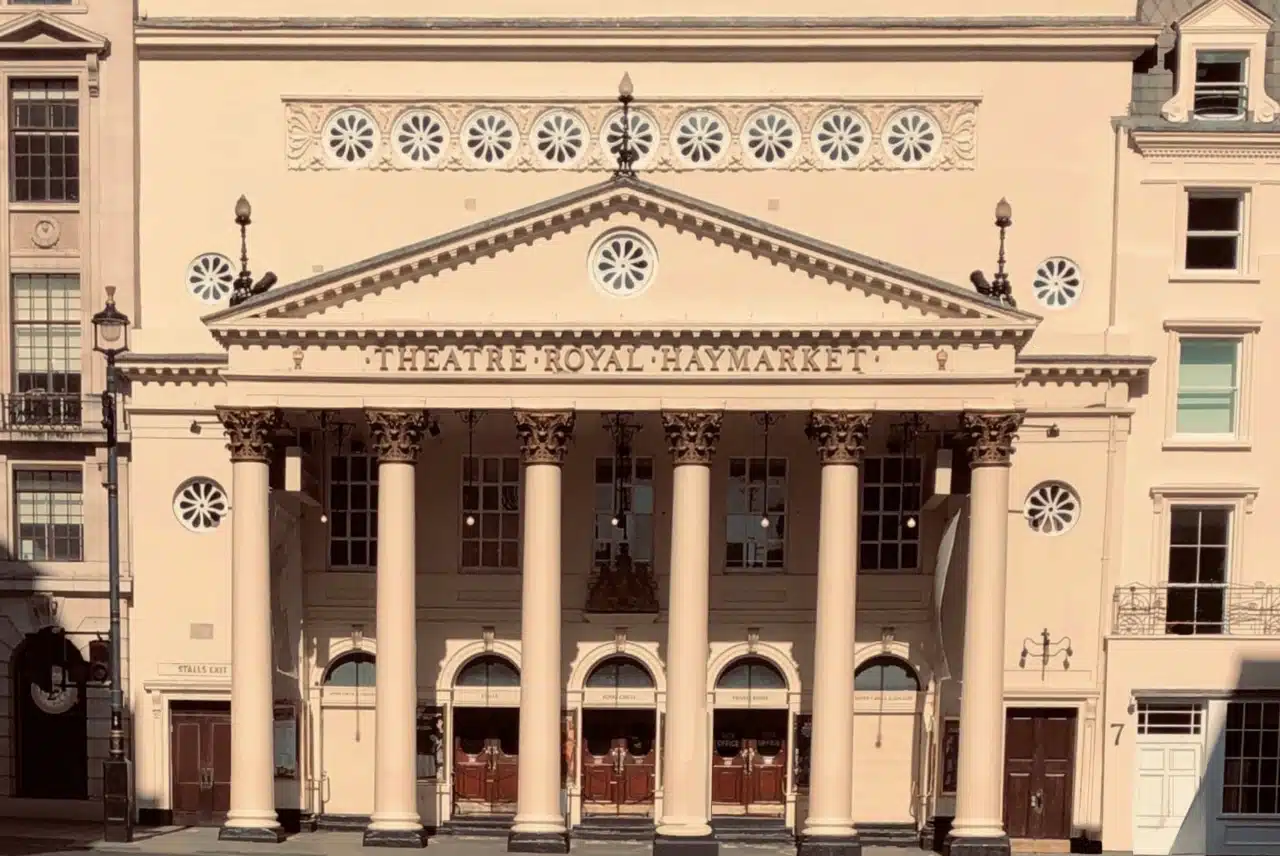
Theatre Royal Haymarket at a Glance
Before we wander into three centuries of theatre history, here are a few essentials about one of London's most storied playhouses.
A West End Story That Starts in 1720
Theatre Royal Haymarket is old enough that its origins belong to a London long before today's West End had fully formed into a theatrical district.
A playhouse opened on this site in 1720, commonly remembered as the Little Theatre in the Haymarket.
That matters because the Haymarket was not merely another theatre trying to join the crowd.
It was there early.
In the eighteenth century, London's theatre world was tightly controlled, with legal restrictions shaping what venues could present and when they could present it.
Even so, the Haymarket developed a reputation for entertainment, experimentation and theatrical resilience.
Not the same building — but the same theatrical address.
The building audiences see today is not the original 1720 structure.
What survives is something even more interesting: continuity.
For more than three centuries, the site itself has remained part of London's theatrical life.
That gives Theatre Royal Haymarket a rare kind of historical depth. It is not simply a handsome old building.
It is a longstanding theatrical tradition attached to a specific London place.

How the Haymarket Became “Royal”
One of the most distinctive chapters in the theatre's history involves Samuel Foote, the actor-manager and playwright closely associated with the Haymarket.
In 1766, Foote secured a royal patent that gave the theatre greater legitimacy and helped cement its future.
The royal patent transformed the theatre's status.
It is the reason the venue became known as the Theatre Royal Haymarket.
That patent also connected the theatre to the complicated licensing rules of Georgian London, when the right to present “legitimate drama” was not casually handed out.
To modern readers, this can sound wonderfully theatrical in its own right: if you wanted to put on serious drama, paperwork and privilege mattered almost as much as talent.
For the Haymarket, that turning point helped move it from an early playhouse into a theatre with lasting institutional importance.
The 1821 Theatre: John Nash Enters the Story
The present Theatre Royal Haymarket dates from 1821, when a new theatre building rose on the site.
It was designed by John Nash, one of the most celebrated architects associated with Regency London.
Nash's name appears all over London history — from grand urban planning to elegant architecture — and the Haymarket remains one of the theatrical landmarks linked to his work.
Regency London still takes a bow here.
The current theatre allows modern audiences to experience a building that reaches back to the Regency era, yet still functions as a working West End venue.
That combination is part of the magic.
Theatre Royal Haymarket is not an architectural relic locked behind museum glass.
It is a historic theatre still doing what it was built to do: gather an audience, raise the curtain and let a room full of strangers pay attention together.

Look Up. The Theatre Is Performing Too.
Historic theatres often do something modern entertainment spaces struggle to imitate:
They make arrival feel ceremonial.
Theatre Royal Haymarket pairs an elegant historic character with the intimacy audiences love in older houses. The room is richly theatrical without losing the feeling of a genuine playhouse built for performance rather than spectacle alone.
The building's appeal lies in that balance: classical dignity outside, atmospheric theatre-making inside.
It is easy to imagine eighteenth-century and nineteenth-century theatregoers here — and just as easy to picture an audience taking their seats for a modern West End production tonight.
The centuries don't feel abstract in a room like this. They feel present.

Notable Names in Haymarket History
A theatre with this kind of history does not collect only playbills. It collects personalities.
Samuel Foote
Actor, playwright and manager Samuel Foote is one of the defining early figures in Haymarket history. His 1766 royal patent helped secure the theatre's long-term status and identity.
John Nash
Although better known as an architect than a performer, Nash's 1821 design is inseparable from the theatre's story. The present building remains one of the great visual signatures of Haymarket history.
John Baldwin Buckstone
The actor-manager led the theatre in the nineteenth century and helped shape its long reputation for lively dramatic and comic programming.
Herbert Beerbohm Tree
One of the major actor-managers of the late Victorian stage, Beerbohm Tree was closely associated with the Haymarket and helped maintain its status as a prestigious London theatre.
Oscar Wilde
The Haymarket is permanently linked to Wilde through the premieres of A Woman of No Importance in 1893 and An Ideal Husband in 1895.
Generations of West End Talent
Across the twentieth and twenty-first centuries, the theatre has continued welcoming leading actors, directors and playwrights, reinforcing its status as one of London's enduring theatrical homes.
That is one of the gifts of a theatre like this.
Managers change. Acting styles change. Fashion changes. London changes.
The address keeps accumulating theatrical memory anyway.
From Summer Theatre to Literary Premieres
Theatre Royal Haymarket has long been associated with comedy, society drama, literary plays and the sort of productions that rely on wit, performance and audience attention rather than sheer scale.
Summer Theatre Tradition
In earlier centuries, the Haymarket became especially associated with summer seasons, partly because of the theatre licensing system and the rhythms of London's stage life.
Comedy & Farce
The theatre developed a reputation for intelligent, lively entertainment — a fitting match for its central London audience and its long-running comic heritage.
Literary Prestige
The Haymarket's history includes important playwrights and high-profile productions, helping it build a reputation that goes beyond simple longevity.
Modern West End Continuity
Today, the theatre continues to host major productions, revivals and star-led runs, proving that historic buildings can remain active players in contemporary theatre.
Two Oscar Wilde Premieres That Keep the Theatre in Literary History
A Woman of No Importance (1893) and An Ideal Husband (1895)
Both premiered at Theatre Royal Haymarket, giving the theatre a lasting connection to one of the most quoted playwrights in English.
That sort of association is exactly why a theatre like this matters.
It is not only old. It is historically active.
Theatre Royal Haymarket Did Not Survive by Accident
Historic theatres can create the illusion that they were always destined to survive.
They weren't.
Over the centuries, London's theatre scene has been reshaped by legislation, redevelopment, changing entertainment habits, war, economics, safety expectations and audience fashion.
The Haymarket lasted because it adapted.
Its story is one of continuity through reinvention.
New building. New managers. New productions. Same theatrical purpose.
The theatre's protected historic status matters, but so does something less official:
people kept valuing it.
Audiences continued attending. Producers continued programming. Theatre-makers continued finding reasons to use the space.
That is how a theatre moves from being merely old to being historically alive.
Theatre Royal Haymarket Through the Years
A theatre opens on the Haymarket site, later remembered as the Little Theatre in the Haymarket.
Samuel Foote secures a royal patent, helping establish the venue's status as Theatre Royal Haymarket.
The present building, designed by John Nash, opens on the site.
The theatre strengthens its reputation through comedy, drama and notable actor-managers including John Baldwin Buckstone.
Oscar Wilde's A Woman of No Importance premieres at the theatre.
Oscar Wilde's An Ideal Husband premieres at the theatre.
The theatre remains part of London's active West End, hosting major productions and continuing its long stage tradition.
The building's Grade I listed status recognizes its exceptional architectural and historic importance.
Theatre Royal Haymarket continues as a working West End theatre, welcoming modern audiences into a room shaped by centuries of performance history.
Did You Know? Theatre Royal Haymarket Trivia
A theatre with more than 300 years of site history naturally gathers a few excellent facts along the way.
🎭 A Theatre Has Been Here Since 1720
The current building dates from 1821, but theatrical life on the Haymarket site reaches back to 1720.
👑 “Royal” Was Not Just Decorative
The theatre's royal title is tied to Samuel Foote's 1766 royal patent — actual legal theatre business, not just branding.
🏛️ John Nash Designed the Present Theatre
The 1821 building links Theatre Royal Haymarket to one of the great architectural names of Regency London.
✍️ Oscar Wilde Premiered Two Major Plays Here
A Woman of No Importance and An Ideal Husband both premiered at the Haymarket.
🎟️ It Is One of London's Oldest Surviving Playhouses
Very few London theatres can trace their site history back as far as the Haymarket can.
🌾 The Name “Haymarket” Really Means Hay Market
The street name comes from the area's earlier commercial life — proof that some of London's most theatrical addresses began very practically.
Why Historic Theatres Matter
Theatre Royal Haymarket proves that old theatres are not old stories.
Historic theatres preserve something books cannot fully recreate:
a living tradition in a real room.
At Theatre Royal Haymarket, the history is not theoretical.
It is architectural.
It is literary.
It is legal, cultural and theatrical.
Most of all, it is experiential.
The audience still arrives.
The lights still shift.
The stage still asks for attention.
That is the difference between preserving a building and preserving a theatrical life.
Life Needs Intermission
Historic theatres need stories. They also need audiences.
OTL Seat Fillers was built around a simple idea: live entertainment is better with people in the room.
OTL Seat Fillers is a private membership club that works with participating theatres, comedy clubs, producers and other entertainment partners to help fill otherwise open seats when available.
Theatre Royal Haymarket is featured here as part of our editorial Historic Theatres of the US & UK series. Featuring a venue in this series does not identify it as an OTL seat-filling partner.
Our partner relationships remain private — but our appreciation for theatre history, famous premieres and beautiful old auditoriums is considerably less secret.
See How OTL Seat Fillers Works
Historic Theatre News & Stories
The history isn't over.
Across the US, UK and beyond, old theatres are being restored, rediscovered, reopened, threatened, transformed and celebrated.
Explore current stories about theatre preservation, historic venues, restoration projects and the people working to keep remarkable stages alive.
Visit Theatre Royal Haymarket Today
Theatre Royal Haymarket remains an active working West End venue rather than a theatre preserved only as a historical monument.
For current productions, tickets, access information and theatre details, visit the official website.
Historic Theatres of the US & UK
Every old theatre has more than one story.
There is the story of the building.
The architects and craftspeople who created it.
The producers and managers who kept it alive.
The playwrights whose words first echoed there.
The performers who stepped into the light.
The audiences who kept returning.
OTL Seat Fillers' Historic Theatres of the US & UK series explores remarkable theatres, architecture, performers, productions, restoration stories and the wonderful bits of trivia hiding behind the curtain.
The collection will also include a dedicated Historic Black Theatres series exploring venues whose stories are inseparable from Black entertainment, entrepreneurship, community, segregation, civil rights, music, theatre and American cultural history.
Because sometimes the building deserves a standing ovation, too.
Go Deeper Into Theatre Royal Haymarket History
If you want to keep exploring, Theatre Royal Haymarket provides official background on the venue, its story and its place in London's theatre life.
It's exactly the sort of subject where you start by looking up one date and end up wandering through three centuries of theatre history.